
Author: dadmin

  • The “until” Verses

    The “until” Verses

    Sometimes the most ordinary words carry a most extraordinary meaning, such as the word until in the Bible. In Matthew 1:25 we see it used concerning Mary, who did not consummate her marriage with Joseph “until” after Jesus was born.

    “But he did not consummate their marriage UNTIL she gave birth to a son. And he gave him the name Jesus.” Matt 1:25 (NIV)

    The Greek word translated “until” in this verse is ἕως which simply means till or until.  It is used to help determine the timing of when a matter occurs.  A perfect example is that of Christ’s command to his three main disciples on the mountain of transfiguration, where he said, “Tell the vision to no one UNTIL the Son of Man has risen from the dead.” Matt 17:17 (NIV)  So even the other nine disciples did not know about that until later.

    The point is that ‘until’ is an ordinary word, and should be understood in the ordinary way, and that is what gives it extraordinary meaning in so many places in the New Testament.  

    Consider this verse:

    “The Lord said to my Lord: ‘Sit at my right hand UNTIL I put your enemies under your feet.’” Matthew 22:44 (NIV) Quoting Psalm 110:1

    Many Christians think the world is going to get worse and worse and then Jesus will return in person, and after that he will subdue every enemy.  The above verse is the most quoted old testament scripture in the new testament, being referenced (depending on how it is counted) about 24 times.  Rather than agreeing with the idea that the world will get worse, it would appear to be saying that Christ is going to remain in Heaven UNTIL all the enemies are defeated.

    1 Corinthians 15:25 (NIV) is another ‘until verse’ that agrees, saying: “For He must reign UNTIL he has put all his enemies under his feet.” 

    That idea puts a cat among the pigeons of many end-times theories.  

    Or consider this verse:

    “Truly I tell you, I will not drink again from the fruit of the vine UNTIL that day when I drink it new in the kingdom of God.” Mark 14:25 (NIV)  The weird thing about this ‘until,’ is that it was only the very next day that Jesus drank wine-vinegar while dying on the cross.  While I’m not dogmatic about it, I have often pondered the question, “Is that an indicator that Christ’s kingdom began with the atonement?”  

    Or consider this set of three verses:

    “So Christ himself gave the apostles, the prophets, the evangelists, the pastors and teachers, to equip his people for works of service, so that the body of Christ may be built up UNTIL we all reach unity in the faith and in the knowledge of the Son of God and become mature, attaining to the whole measure of the fullness of Christ.” Ephesians 4:11-13 (NIV)

    The debate about the church having or needing apostles seems to be settled by the ‘until’ here, because Christ gives them to His people to perfect them until they measure up to God’s ultimate standard… which of course hasn’t happened yet.

    The ‘until verses’ are among some of the most interesting in the New Testament because they demonstrate that the original apostles thought differently to us on a few points.  So it’s a reason to go to the Bible and get to know it all the more. 


  • The Number 1000 in Scripture

    The Number 1000 in Scripture

    Source: Aaron Lee on Unsplash

    There’s something to know about the interesting number, one thousand in the Bible.

    In the Koine Greek language the word used is χιλιάς (kilias) which is where we get the word ‘kilo’ in English, as used in kilometre (a thousand metres) or kilogram. (a thousand grams)  And, in the Hebrew language, which is written mostly using the Aramaic square script, the word for thousand is אֶלֶף (elep).

    The word for thousand can be used either literally or figuratively, and is used both ways in both languages in both the Old and the New Testament.  

    For example, here is the word a thousand used specifically in the Old Testament, and specifically (that is literally) in the New Testament:

    “To Sarah he said, “Behold, I have given your brother a thousand pieces of silver.” (Gen 20:16)  Literal – Old Testament Hebrew.

    “Those who ate were about five thousand men, in addition to women and children.” (Matt 14:21)  Literal – New Testament Greek.

    When we read passages like these, the number a ‘thousand’ reads normally.  However at other times the word is non-literal and comes to represent something else, such as in these examples from both the Old and New Testaments.

    “For every animal of the forest is mine, and the livestock on a thousand hills.” (Psalm 50:10)  Non-Literal – Old Testament Hebrew.  

    Or

    “For a day in your courts is better than a thousand elsewhere.” (Psalm 84:10)  Non-Literal – Old Testament Hebrew.

    To read the above two Psalms literally would mean that God only owns the cattle on a thousand hills, but the parallelism of the verse shows us that God is using the word “thousand’ to refer to “everything.”  So he owns the cattle not just on a thousand hills, but on all of the hills.  And in the second psalm, a day in the Lord’s courts is better than all of the days of time anywhere else.  

    So when we encounter the word ‘thousand’ in scripture, how do we know if it is literal or non-literal in its usage.  The passage is often the clue.  For example the psalms are poetry, and thus we have poetic language, including the use of many non-literal terms.  Other passages in the Bible like the story of Isaac obtaining a wife in Genesis 20 are narrative, so we have a story with the actual price paid for his wife’s dowry, being a thousand pieces of silver.  

    How about the millennium passages from Revelation twenty?

    “Then I saw an angel coming down from heaven, holding the key of the abyss and a great chain in his hand. 2 And he laid hold of the dragon, the serpent of old, who is the devil and Satan, and bound him for a thousand years.” (Rev 20:1-2) 

    Many people have interpreted the word thousand here literally, but there is a clue that it is in fact non-literal.  Consider the other things in this verse:

    • The Abyss is not a literal abyss.
    • The chain is not a literal chain… 
    • The dragon is not a literal dragon.

    If the other elements in these two verses are non-literal, what about the word thousand?  I suggest the word thousand is also non-literal.  

    When the book of Revelation says that Christ is going to reign for a thousand years, and the devil is going to be bound for a thousand years, perhaps that is a non-literal expression for a very very long time.  In other words, the Lord will be King of the Earth, not just for a thousand years, but…


  • What the Bible says about the Effect of Humanity on the Environment.

    What the Bible says about the Effect of Humanity on the Environment.
    Source: Wikipedia. (User: Diliff)

    Standing on the edge of Sydney’s Blue Mountains, it is easy to see that the world is pretty awesome, reminding us of the Creator and what he has done.  However, according to scripture the world we live in is a corrupted version of the original creation.

    When Adam sinned, it wasn’t a problem for him alone, but for all humanity after him, and along with it all creation was plunged into pain.  God said, “Cursed is the ground because of you; through painful toil you will eat food from it all the days of your life.  It will produce thorns and thistles for you.” (Genesis 3:17-18a) 

    Later in the book of Romans, Paul described the fall using these words, “For the creation was subjected to frustration, not by its own voice, but by the will of the one who subjected it…. We know that the whole creation has been groaning as in the pains of childbirth right up to the present time.” (Romans 8:20&22) 

    The creation we know, the Earth and the Universe as we see it, is like a corrupted hard drive on a computer.  It doesn’t work properly and is not what was originally built.  

    One could say that humanity has had a significant impact on the environment.  

    There is a lot of debate today about climate change and the environment.  The temperature seems to be gradually warming, and the question is whether this is good or bad, and caused by people or by natural causes.  

    But the original environmental devastation was certainly of human origin, and incredibly destructive.  The world we are living in now is a shadow of previous version.  

    So… If you ever hear someone say how beautiful the world is, and how finely tuned it is, and how it is evidence of a Creator.  They are speaking the truth.

    And… you may also hear someone else say how the world could not have been created because it is full of death, disease, wars, predators, natural disasters and more.  They are kind of telling the truth too, because the world we live in isn’t the world that was created.  So both points of view are correct.

    What is left for us to do?  Fall on the mercy of God, and find your way back to Him.  It is the beginning of a wonderful walk with the creator of life. 


  • Is the World Just Beginning?

    Is the World Just Beginning?

    There are many perspectives that believers have on the timing of things that God does with the Earth.  

    In terms of when the world started, believers who take the creation story at face value (literal creationists) believe the world was created just six thousand years ago, so it is young.  But believers who take a theistic evolutionary approach think the world is four billion years old.  That’s quite a difference.

    In terms of when the world will finish, dispensational believers and many premillennial Christians think the world will be over any day, so it has a short future.  But amillennialists and partial-preterists are open to a longer time frame, some of them up to millions of years into the future before Christ appears.  I will soon write a blog on the scripture that can back the idea of a long future.  

    So with those four perspectives, the two variations on the timing of the beginning, and the variations on the timing of the future, you end up with four rough timelines like this.

    The Four Views:

    1. TED: Theistic Evolutionary Dispensationalists.
    2. TEP: Theistic Evolutionary Partial-Preterists
    3. LCD: Literal Creation Dispensationalists
    4. LCP: Literal Creation Partial-Preterists.

    The first view is those with a long view of history, but a short view of the future.  For them, they have a perspective where for millions (even billions) of years, sin and death have ruled and reigned, and Christ comes basically to change that and finish things up.  The atonement comes as a last gasp right and the end of history as the timeline shows.  Under this viewpoint, what advantage is there for God to wait so long before coming?  And then why is God returning so quickly to wrap things up when billions of people are not aware of him.  

    The second view is of those who hold to both a long future and a long history.  For them, the atoning work of Christ comes right in the middle of human history as the timeline shows.  One would ask if this perspective is true, why would God place his work right in the middle, other than perhaps for symbolic reasons?  

    The third view is of those who take creation literally, so the Earth has only been around for six thousand years.  They also hold to a short future, which can end as soon as today.  The timeline looks as below.  We would ask, why does an eternal God wait until so late percentage-wise (about 66% of human history) to come?  And why does he return back so soon with billions of people still unaware of who He is, and having no chance of salvation?

    The fourth and final view is those who also believe in a literal creation, but consider the idea that Christ has much yet to do, so there will probably still be a long future.  For them Christ has stepped into history immediately at the atonement, and is giving people time to grow and change and find him.  He is as much concerned about individual salvation as he is about nations, and wants to redeem the world and restore it.  So he is concerned about both eternal things, and temporal things.  

    Having read the scriptures, and studied it my entire life I am convinced that God is patient and kind, and his heart is the save all who will respond.  For me there is also no reason to doubt the literal creation account.  While some have claimed the early chapters of Genesis to be metaphor, there isn’t evidence for that.  Moses who wrote it came from the only ancient culture that did write regularly in prose and narrative, because it was a straight telling of what happened.  Science also seems to raise more and more doubts about evolution as an idea, and as time advances, the Bible seems to be becoming more and more trustworthy in the minds of academics such as biologists, physicists, archaeologists, linguists and more.  

    Believing as I do in a young earth with a long future, I marvel at the genius of God.  As soon as the problem of sin happened he was at work.  His son came at just the right time to bring salvation.  And the grace of God is at work in the world and will continue for as long as it is needed, even if that be for millions of years to come.  


  • Double Language in Scripture

    Double Language in Scripture

    The Bible is full of language that sounds clear, but turns out to have another meaning.  It’s straightforward once you know what the true meaning or meanings are, and we can recognize that the disciples were confused by this at times, but so often we ourselves get confused too, but often we don’t realise that we are.

    A great example of double language is in John’s gospel where Jesus tells his disciples “I have food you don’t know about” (John 4:32)  That comment sparked a conversation about his apparent hidden food and how he got it without them knowing.  Preachers often label this type of thing figurative or metaphorical language, and observe that Jesus often had special spiritual meanings behind his use of everyday language.  

    Can I suggest to you that Jesus is not trying to use regular words to hide a special meaning, but instead trying to explain a deep and much more real thing, by using something we relate to.  

    Imagine someone born blind, and not having any idea of what light was or what the colors were.  If you had the task of explaining it to them you would try to relate something to them they did understand.  So you would perhaps use the volume and types of sounds to explain brightness and the types of colours.  In reality sound and sight are quite different, but to the blind only knowing one of the things, the other is a “greater reality” which we try to convey to them.  We have to use something similar to point to something a bit different but greater and hard to understand.  

    God in the Bible, and Jesus in person both used language like this from the very first chapters of the Bible to speak to us.  But rather than seeing it as an attempt to hide meaning, is it an attempt to explain something much greater using earthly analogies.  There are things going on in the mind and heart of God, but we are much to earthly to get a sense of them, and yet there isn’t any way of explaining them except in terms of things we understand.  For this reason the Jews of Christ’s day thought he was coming as a physical king to sit on a physical throne.  But Christ has a different type of kingdom in mind.  Today there are many people who are still waiting for Christ to come and sit on a physical throne, and waiting for a third physical temple to be built, and waiting for a new Jerusalem that they believe is physical and will come out of heaven.  So often we cling to the apparent meaning, and don’t see the thing which is more real.  

    In Genesis 2:17, God said to Adam not to eat the fruit of a certain tree, saying “you must not eat from the tree of the knowledge of good and evil, for when you eat from it you will certainly die.”  In the next chapter both Adam and Eve did eat from that tree, but both continued to live in the way we are accustomed to thinking of living.  So in what way had they died?

    It turns out that there is a death worse than the death we are familiar with.  Or there is a death that is more real than the reality of death we know of.  In other words there are two types of death.  Scripture actually does talk about the first death and the second death.  Being thrown into the lake of fire is “the second death.”  (Revelation 20:6)  There are also two resurrections, or two lifes we might say.  The first resurrection is when we are born again and our spirit lives for the first time.  Prior to that we are “dead in our sins.”  The second resurrection is the one that happens on that grand final day when Christ returns.  The first death is the physical death of our bodies, but the second death is the permanent separation from God.  But in a sense many people are already dead with that second death, because they are not alive to God.  

    So there is double language used of almost everything in the Bible.  We are told in John 6 to “eat my flesh,” which many have equated to physical things, believing that the communion host actually turns into Jesus body, rather than noting a greater reality at work.  Jesus said he was building another temple, but it is the joining of the lives of his people together… a building not made of hands, which is a supremely more significant thing than another middle-eastern building project.  

    The problem with double language is that we think we know what it means, and we settle for the superficial meaning, and don’t find the greater reality of what God is doing.  God is trying to get our attention with big things. 


  • New Space Images Support My Book

    New Space Images Support My Book

    In 2019 I started writing “Flag on the Glacier,” a book-sized letter to atheists a thousand years in the future. One of my goals was to get the book published before the launch of the James Webb Space Telescope (JWST). The reason for that was simple, I had a feeling that the data coming back from the telescope was going to confirm what I would write about. Writing about the future is challenging, and I really wanted to try to be accurate, but in the case of what I was to say about space, and its implications about God, I was certain.

    When COVID hit the world in early 2020, we were just months away from the (at that time) launch date of the new space telescope in May. But my book was nowhere near complete. However, due to both COVID complications, and technical issues, the eventual launch ended up being Christmas Day, 2021. I consider that the launch, on that day, represents what the telescope is… a “Christmas gift” to the world.

    It took about six months for it to travel to its point in space (lagrange point 2) and to be provisioned, and since then we have started to see some oof the most remarkable images released. To see some of those, go to https://webb.nasa.gov/

    My thesis is that as time progresses we will come to a point where everyone will believe the world was created, and that somoe intelligent form (ie God) is behind it all. Even future atheists will concede this point. I postulated that the JWST would demonstrate that the universe is infinite, becuase it shows us what God is like. So now that articles like the below one, are surfacing, it is nothing suprising to me, but a great confirmation oof what I knew to be true. Click the image below to read the full article at Sky & Telescope.


  • How The World Has Changed

    How The World Has Changed

    In ancient times human life held little value. Indeed gladiatorial games were even held for entertainment in which people were killed for sport. There was no Emporer more depraved than Commodus when it came to the arena. If someone had suffered a cardiac arrest during a game – it would probably not have raised an eyebrow.

    Later in 391AD or so, Telemachius jumped the fence at what was believed to be the Colosseum to try and stop a fight to the death. He was himself killed, but becamse the catalyst for the banning of gladiatorial contests. His Christian values came from scripture, and the teachings of Christ that people do have value because of being made in God’s image.

    Sport now exists in many forms, for the purpose of entertainment, with American football (NFL) being an example of a high-risk physical sport where players are routinely injured, hence the helmets that must be worn. Physical contests like the NFL, Rugby, Boxing, Wrestling and more are the closest thing we have to the games of ancient times.

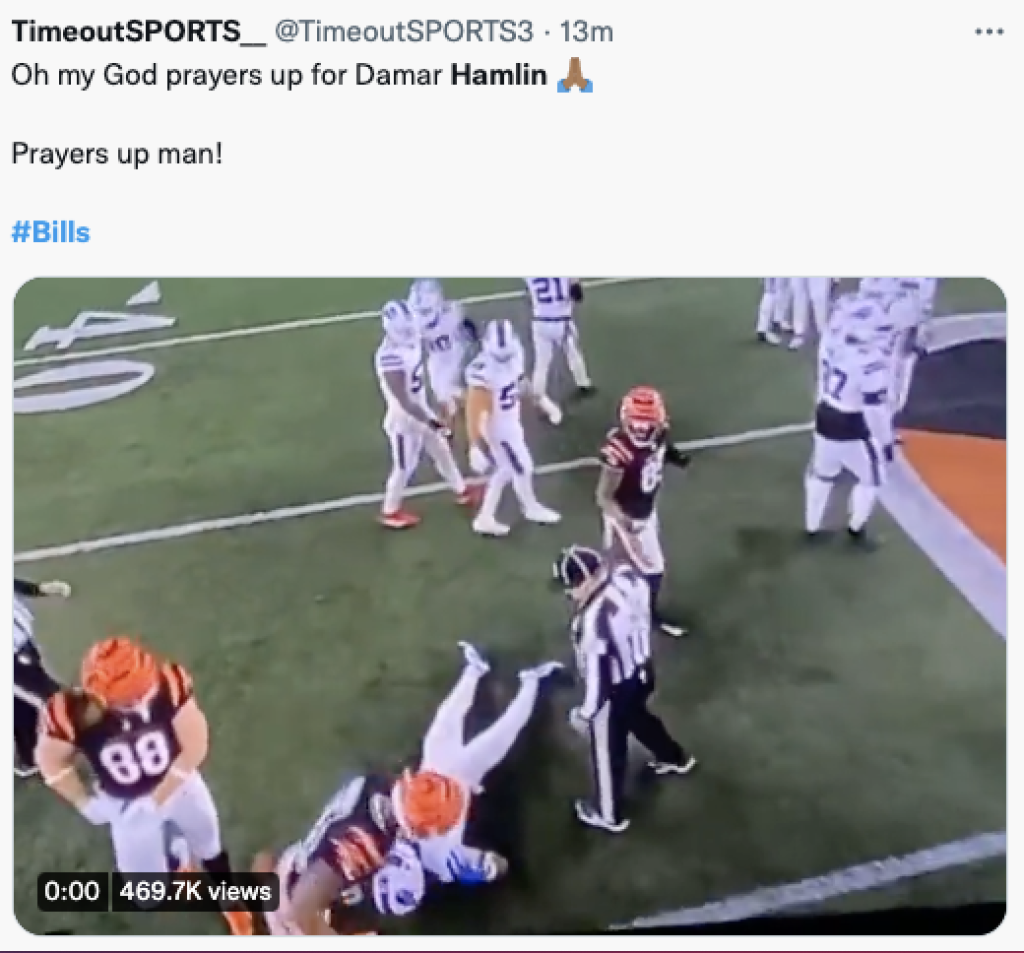
    On January 2nd, 2023, in an NFL game between the Buffalo Bills and Cincinatti Bengals, Damar Hamlin was hit in a heavy tackle and dropped to the ground experiencing cardiac arrest. He was resucitated onfield, and taken away in a ambulance and the game was then cancelled. The below image shows his team plus others praying for him, as an ambulance takes him away. Others at the stadium including players and supporters of the other team where in prayer too.

    At the same time, even before an ambulance had arrived, posts like this below exploded all over the internet.

    Within hours the amount of posts about people praying was in the millions. People who don’t even have faith were saying prayers.

    Even news agencies were calling for prayer:

    And the Buffalo Bills official website – requested prayer right across the top of its website.

    What happened after Damar’s life-threatening injury was an outpouring of prayer, love and concern, which demonstrates how much the world has changed. Human life is more important than any game, as demonstrated by the cancelling of the rest of the event. What began with Jesus Christ and his words to love and value humans, has worked in cultures, languages and groups of people to bring the most profound changes to the world.

    What happened in Monday Night Football in just one example of how the world is different because of Jesus. Jesus laid down his life so that the lives of others could be saved, and set an incredible example which has an increasing effect even today.

    A week later, Damar Hamlin is out of hospital, having spent days in ICU. This image from an ABC article says it all.


  • The Seven Israels

    The Seven Israels

    Today as I write this, it is remembrance day.  104 years ago to the day, the guns stopped firing in World War 1, and nations laid down their weapons for peace.  While the peace didn’t last and was temporary, it reminds us of a peace that does last, and the gospel that brings us eternal peace.  

    One of the biggest misunderstandings that hindered believers in the past, and still hinders some today, from finding peace with their fellow believers is the issue of Israel.  There was a gulf between the Jew and the Gentile which only the gospel was able to span.  Paul called that revelation a “mystery” which doesn’t mean something mysterious we don’t understand, but rather something that was hidden or a secret, but later revealed.  

    The idea of Israel begins with one man in scripture, and develops to be many things, but it ends up including all the Gentiles.  Nobody would have seen that coming, hence why it was a ‘mystery’, a secret.  Today we sit on the other side of that revealing.  We know that there are many ways the word Israel can be used, and its always important to be clear about what you mean, when you use the word Israel.  

    Here are seven ways Israel is used in language.

    1. Israel was a person.  Jacob wrestled with God because he was distressed over his future and his family’s future, and he would not let God go until he was blessed.  God changed his name to Israel, one who wrestles with God.  All of us are called to wrestle with God too.  See Genesis 32:28
    1. Next, the biological descendants of Jacob began to be called the “children of Israel” or Israel for short.  This included all his twelve sons, their wives, an all those with them, slave and free.  So Israel came to be the descendants of Jacob as a people.  They came to be called Israelites.  A great example is Pharoah’s statement… “I will not let Israel go.”  See Exodus 5:2
    1. As Israel entered the land of Canaan a nation was established, this became the biblical undivided nation of Israel.  This nation was initially a theocracy – ruled by God, and that was how the Lord intended it.  Later they wanted a king and it became a monarchy, with Saul as the first king, but he failed them badly.  In 1 Samuel 24:19-21, Saul admits to David that he knows the Lord has delivered to him the nation of Israel, and asks him to promise to be kind to his descendants after him, which David does.  The third usage of Israel refers to a biblical nation.
    1. Later the nation was divided in civil war during the time of King Rehoboam.  Two of the tribes went on to be called Judah, from where we get the name Jews, and the word Jewish.  The other ten of the twelve tribes were called Israel, but were not representing all of Israel, but a majority of it.  The nation of Israel now turned away from God.  A number of kings of Judah were described as evil, like Ahaz for example who walked in the ways of the kings of Israel.  He wasn’t counted as Israel, but he was copying Israel.  See 2 Kings 16:2-4
    1. It gets much more interesting in the New Testament where we see that Christ is Israel.  Straight away in Matthew’s gospel Jesus is being compared to Israel.  Matthew 2 quotes Hosea 11 where it says “out of Egypt I called my son.”  Israel initially came out of Egypt as a nation, but now it is Christ who comes out of Egypt as a baby.  Back in Exodus 4:23 God told Pharaoh to “let my son go.”  So we see this example of how Jesus is the true Israel of God.
    1. Then just as the descendants of Jacob became Israel, so we the believers in Jesus have also become included in Israel.  And we find out that there was never a separation between Jew and Gentile in God’s mind.  HIs plan was for one flock all along. (John 10:16)  Paul saw it and wrote about it most clearly saying that the church is the “true Israel” and that includes true jews of faith, and true gentiles of faith, it is not a rejection of either, but an inclusion of both in Christ.  In his letter to the Galaatians (6:16) Paul writing to non Jewish believers says that all who walk in Christ are the Israel of God.  
    1. And finally…. we have the modern political nation of Israel today which occupies more or less the same historic land that the historic nation of Israel did.  The historic nation was a theocracy based on the law, and later after the civil war a divided nation, but still with a temple, priesthood and sacrifices.  The modern nation of Israel is a democracy with a prime minister, and mostly secular, but with rabbinic Judaism practised by some.  Mosaic Judaism (temple/sacrifices/priests) is no longer a reality.

    In summary, it’s good to be clear that the word Israel is used in many different ways.  When we see an Old Testament prophecy referring to “Israel”… don’t assume it must be speaking of the modern democratic political and mostly secular nation labelled Israel.  It makes much more sense that it speaks of Christ and the Church, as the majority of prophecies do.  


    On this remembrance day, let us quote Paul in concluding, and remember that Christ “is our peace, who has made the two groups one (Jews & Gentiles) and has destroyed the barrier, the dividing wall of hostility.” (Eph 2:14) 


  • Why the Date of the Book of Revelation is Important

    Why the Date of the Book of Revelation is Important

    It turns out that the dating of Revelation has a HUGE impact on the potential interpretation of it, and the behaviour of its readers, and even entire countries.

    If you believe that Revelation was written before 70AD, then it was written before the destruction of the second Jewish temple, and the destruction of Jerusalem. Knowing that, everytime the temple is referred to in the book, it is assumed to be probably talking about that actual temple that was standing at the time. It lends to a more “back then in history at the time of the early readers” type of intepretation. People who intepret it that way are sometimes called “preterists” or “partial preterists. They are not clamoring for a third temple to be rebuilt, and not thinking that Israel in the world today is God’s special country. This interpretation, leads to a less complicated outlook of the future, and they are not constantly watching the nation of Israel for everything it does, believing our future is tied to what happens there.

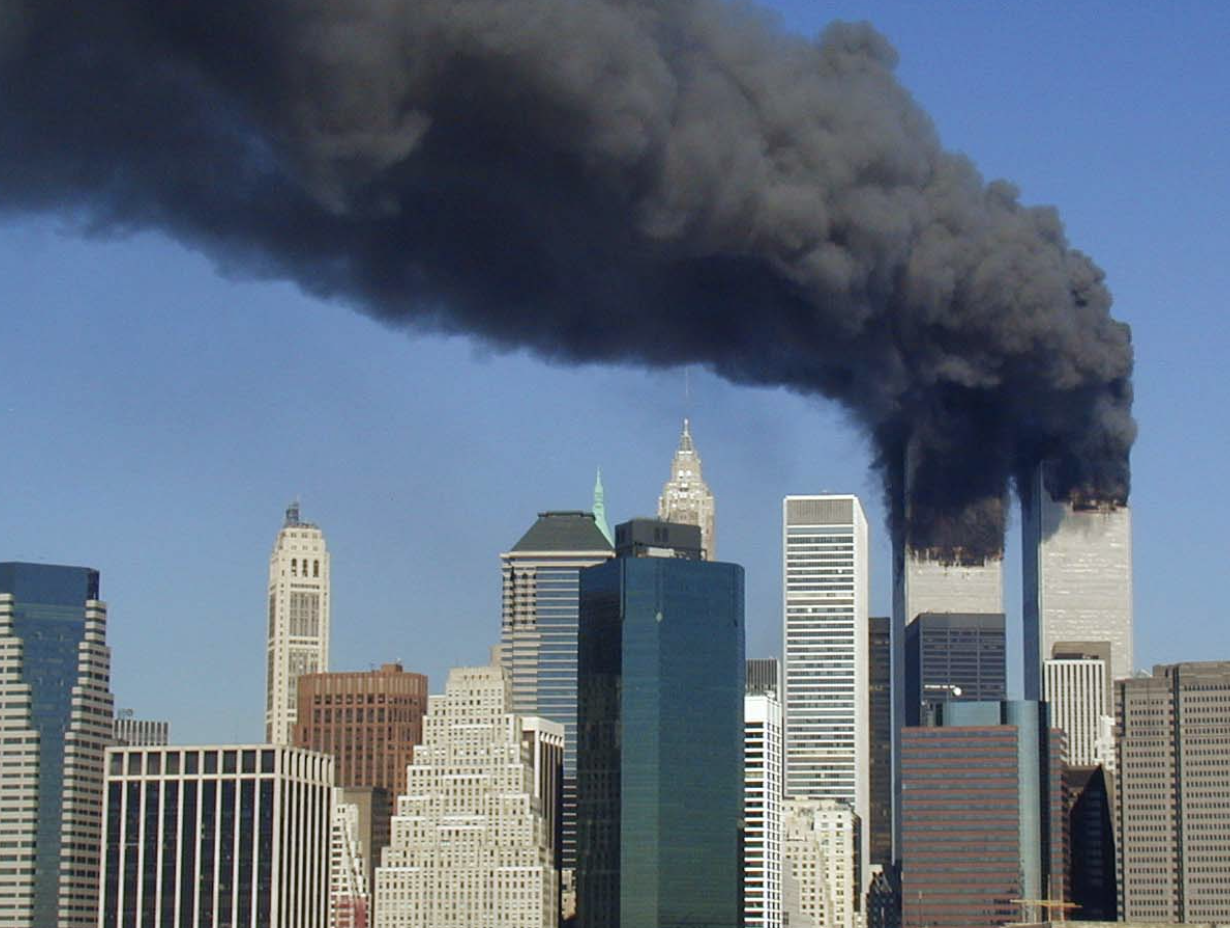
    If however you think the book is written after 70AD when there was no temple, then people will conclude there is going to be a third physical temple built, and the believe that our future is somehow tied up with the present nation of Israel. Some are even donating money to the Temple Institute to build it as soon as the opportunity arises. Hundreds of thousands of people support Israel, and all it does, including the blockade of Palesinians in Gaza, and the clear human rights abuses that happen day after day against Palestinians, some of whom are even Christians or Jews. Christians support many terrible things like this believing it is God’s will to do so, and “whoever blesses Israel, will be blessed.” Then you have things like 9/11 that happen in retaliation against this apparent Christian support of Israel, because Al Qaeda understood it as a type of Christian persecution against Muslims. You can see this in the speeches of Osama Bin Laden. (just google for that)

    There are some very real world decisions and actions taken based on assumptions made about Israel and the End Times, but a lot of this would be different, if a different date for Revelation was clear.

    The Temple/Israel issue is just one thing that is important, that the dating of Revelation impacts.

    Here is something on the date:

    In recent times a large group of acaemics, and hence pastors who are taught by them at Seminary, have believed that Revelation was written later than other books in the NT – maybe around 90AD in the time of the Emporer Domitian. (From 81–96 AD). This late date is based on one half-reference by an early church father called Irenaeus.

    Here is the quote:

    “Had there been any need for his name to be openly announced at the present time, it would have been stated by the one (John) who saw the actual revelation. For it was seen not a long time back, but almost in my own lifetime, at the end of Domitian’s reign.” (Against Heresies, 5.30.3)

    It sounds like John saw the Revelation in the time of Domitian’s reign. However if you know a little Greek, the grammar is completely unlike English, and it could equally have been translated something like this.

    “Had there been any need for his name to be openly announced at the present time, it would be been stated by the one (John) who saw the actual revelation. He was seen not a long time ago, in my own lifetime, at the end of Domitian’s reign.”

    Ireaneus was not clear with his words because they could mean that John saw the revelation later, or that John himself was seen by them later. And apart from that semi-clear reference, there is not much else to suggest a later date, but a LOT that suggests an earlier date.

    The book which outlines it all is “Before Jerusalem Fell” by Dr Kenneth Gentry, which is roughly speaking a rehash into his PHD Thesis on the topic.

    In recent times more and more experts are concluding that there is strong evidence that John wrote his revelation during the reign of Nero – around about 60AD. Then the events in Jerusalem and the destruction of the temple fit very nicely the things that were “soon to take place.” (Rev 1:1)

    Interestingly, a nickname for Nero back then was “the beast.”


  • Can the Dead Hear?

    Can the Dead Hear?

    John chapter five contains an event where Jesus heals a man on the Sabbath and tells him to carry his matt and walk. In the minds of the Jewish leaders, this equated to working, a thing which was not supposed to be done on the Sabbath day. Jesus clearly saw it differently and considered healing someone a great thing to do on any day, not only a Sabbath, and walking away with his matt was not working in Christ’s mind.

    After this event, we have discussion about it from verses 16–30. The Pharisees accuse Jesus of breaking the sabbath, and Jesus comments back. In the story we have a contrasted example of one group who heard Jesus speak, but rejected it, and a man who heard Jesus speak and did as instructed. The subject is thus about hearing God’s voice. In this context, here is what Jesus says:

    And

    It is not hearing with the physical ears which is the subject of verses 24–25, but rather hearing in the sense that you ‘understand.’ And in that quote, the ‘dead’ which are the spiritually dead will live. In other words, if you are spiritually dead, but you truly hear God’s words…. it sinks into your heart and you understand and receive it… you are changed and will live. This is the essence of believing God. It isn’t just believing that there is a God, because the Pharisees believed there was a God, but they rejected Jesus words and didn’t ‘hear’ him.

    In the second quote it is now talking about everyone who is physically dead, and about the final judgement. Jesus now says that in this situation everyone will hear his voice, and rise to be judged, some rewarded and some punished. So the two quotes are talking about two different types of dead, and two differnet types of hearing, and two differnet types of result.

    In the actual story, the Pharisees were dead, and did not hear the voice of God in Jesus. The disabled man who was healed did hear the voice of Jesus and received life.

    The question remains, do you ‘hear’ Jesus?


  • Queen Elizabeth II and the Lord Jesus Christ

    Queen Elizabeth II and the Lord Jesus Christ

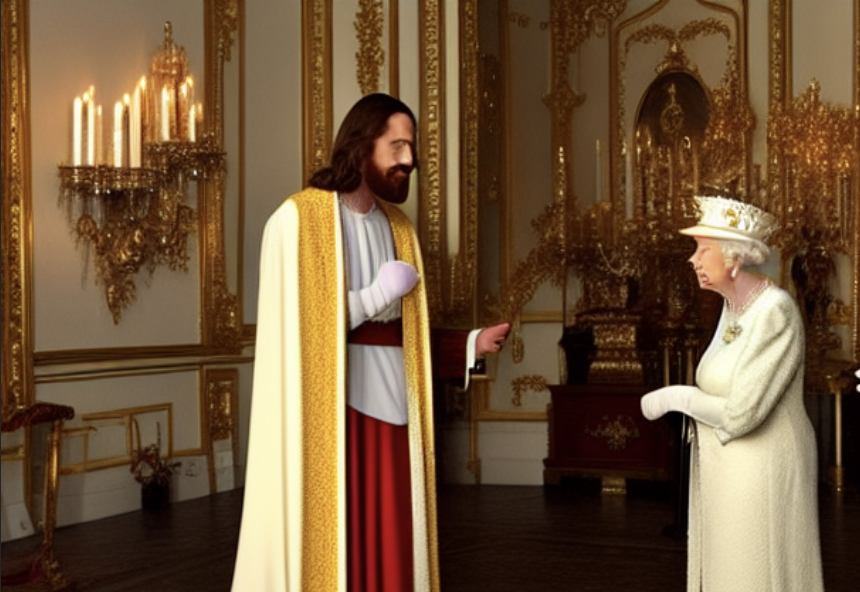
    Queen Elizabeth II has been a rock of stability for the world for the last seven decades. When I lived as a child in Papua New Guinea she came in 1985 to commemorate 10 years of independance and I saw her. A memory I will never forget. Presidents and Prime ministers have come and gone, but she has remained. Her calm manner has been a source of confidence for many, living through World War 2, the cold war, the fall of communism, terrorist years and everything in between.

    Can I suggest that the Queen’s faith is what gives her such confidence. And can I further suggest that it is in fact God himself which gives the world its stability. God knows we need stability and so He gives us people like Elizabeth of Windsor. She has been a gift of God to the 20th century, and rather than worrying about the future, we can rest assured that the same God is still there. God will provide other gifts.

    The Queen may have reigned while 13 US President came and went, and while a multitude of other world leaders changed over, but God has reigned on His heavenly throne before the Queen, and will continue.

    There is one rock of stability and it is none other than Christ.

    Malachi 3:6 “I am the Lord, I do not change.”


  • Can You See God?

    Can You See God?

    You don’t see God with your eyes, unless something very out of the ordinary happens. There are other ways of seeing Him.

    God is a spirit (John 4:24) so he is “made” of spiritul ‘matter’ and not of atoms. Spiritual things are real, and in fact are the most real thing that there is. Basic philosophy informs us that somethign must have existed before atoms, or nothing could exist. This pre-existing ‘matter’ is the spiritual nature of everythign that undergirds all reality…. essentially God himself.

    One question that atheists think stumps Christians is “who made God?” But in fact that question is the key to the proof that God exists. If God was a created entity, we would then ask the question again, who made that, and then who made that, and them who made that.

    The “who made that” question could be asked an infinite number of times… but eventually you must come to a point where something existed that was not made, and was not physical. There must be a permanent and eternal spiritual entity or otherwise nothing would exist at all. And that is God.

    So… because God is not made of physical matter the only way for him to be physically observed is for something supernatural to happen, he must ‘physicalize’ himself temporarily to be seen, or otherwise cause your physical senses to see non-physical things. Both are equally unusual, so an out of the ordinary event must happen.

    However, God is seen in other ways, and many people have ‘seen’ God. There comes a moment in your awareness, that you recognize God is with you, or doing things in your life. While He isn’t physically observed, he is observed just the same – you have seen him. For me this first occurred as a four year old when I prayed to receive Christ into myself. I changed. He was real. I cannot eplain the experience, except that I saw God. Those without my experience can write it off with various excuses, but I have continued to see God regularly.

    Pray for your eyes to be open in the manner I’m talking about. Visions do happen, and we cannot rule them out, but more likely is you will become aware of God’s reality.

    Occasionally, someone only wants to prove that God doesn’t exist, so they pray a prayer like this deliberately not expecting anything to happen, and deliberately wanting (let us say believing) for nothing to happen. This is faith for nothing, and nothing is what they will get. This becomes a self-fulfilling prophecy and they are confirmed in their doubt. They get what they want, which is to not know God. God is smart enough to know they don’t want anything to do with Him, so he will never been seen by them.


  • Will the Rapture Occur after Everyone has Heard the Gospel?

    Will the Rapture Occur after Everyone has Heard the Gospel?

    I used to think that the rapture could not possibly happen until everyone had a chance to hear the gospel. This was based on two verses:

    Firstly Matthew 24:14 which states “And this gospel of the kingdom will be preached in the whole world as a testimony to all nations, and then the end will come.”

    And secondly 2 Peter 3:9 (Message version) “Don’t overlook the obvious here, friends. With God, one day is as good as a thousand years, a thousand years as a day. God isn’t late with his promise as some measure lateness. He is restraining himself on account of you, holding back the End because he doesn’t want anyone lost. He’s giving everyone space and time to change.”

    However I have since learned a few things…

    Matthew 24 (up until about verse 31/32) was not talking about. the end of the world, but the end of the Old Covenant, an the destruction of Jerusalem. The word translated world in verse 14 is ge which is not normally translated as ‘world’, it is better translated as ‘land’. We usually get the word ‘world’ from the greek word cosmos, which is not present here. Because of the assumptions of translators they assume it is about the final end, so they translate world instead of land, and they translate nations instead of tribes. Rather that verse should say somethign like this….. “the gospel will be preached through the whole land as a testimony to all the tribes, and then the end will come.”

    Matthew 24:14 is saying that before Jerusaalem is destrooyed, the gospel emssage was to be preached to aall the tribes of Israel. The needed to know that Christ was teh messiaah, becauase the mosaaic form of Judaism wasa going aaway. The temple would be destroyed and they were being called into following their messiah, Jesus Christ. This was also the precisely the reason why Jesus said earlier to his disciples this in Matthew 10:23 “When you are persecuted in one place, flee to another. Truly I tell you, you will not finish going through the towns of Israel before the Son of Man comes.”

    I have since come to see that Christ will not return to secretly rapture believers, leaving all the unbelievers alone, and then later return again. There is only one return of Christ, not two.

    What has become more and more apparent is that Christ IS a very patient God, just as 2 Peter says, and he delays his return so that the world can be saved. He isn’t going to come back quickly and send billions of people to Hell. But at the same time, he isn’t coming back twice either – with a secret return, and then a visible return. There is only one second coming of Christ, and “every eye shall see him.”


  • What Happened to the Canaanites when Joshua Invaded?

    What Happened to the Canaanites when Joshua Invaded?

    The people of Canaan represented a number of “tribes” such as the Girgashites, Perizites, Gibeonites and more.

    The book of Joshua shows us that he was commanded by God to completely destroy these nations from the land, and they did so in two southern cities, Jericho (Joshua 6) and Ai, (Joshua 8) and in at least one northern city Hazor. (Joshua 11) All three of these cities were destroyed by fire.

    The Gibeonites mounted a deception – (Joshua 9) pretending to be from a foreign land, and made a treaty by which they preserved themselves, but in theory the other tribes were not safe. However it is pretty clear from the biblical accounts that Joshua and the Israelites failed to complete the task assigned them.

    According to the Bible, the culture of the land was so hideous, violent, and bloodthirsty that it had gone too far to be redeemed and had to be removed. One example is the child sacrifice that was a widespread practice through the land of Canaan. Burning children alive before the idol molech is one example. The situation was significantly evil, or at least that is how I have come to undersand it.

    The book of Psalms describes the outcome using Ephraim as a metaphor for all Israel… “the archers of Ephraim turned back on the day of battle.” (Psalm 78:9). My guess is that didn’t have a stomach for ongoing warfare, and having come out of a history of slavery were also not hugely experienced in warfare. They were just haappy to have somewhere to settle down.

    So in most cases the Canaanites ended up co-existing alongside the Israaelites – in some cases the Israelites destroyed them. The struggle that many people have today is why would God command something that appears to be a genocide. There are good answers to this question, but most significantly, we lack the context of how horrible the situation was on the ground, and how righteous God is.

    The story of Joshua cannot easily be removed from the Bible, and it does need to be understood as a part of the whole. It illustrates how Godo hates evil practices – similar to the Sodom anad Gomorrah story, and the Noah’s ark story, and is a reminder that there is an impending judgement for all people.